Trussal
Exploring Latency, Jitter, and Packet Loss as Audiovisual Aesthetics in a Gesture-Enabled, Browser-Based Networked Live Coding Platform
Quargs Greene
quargsgreene@gmail.com
@quargskpgreene
Trussal is a multimedia live coding environment built on top of Jitsi Meet. JPattern is the domain-specific pattern language enabling live coding in Strudel and Hydra, as well as using text, CSS, and meeting reaction patterns. MediaPipe enables users to live code without using an external keyboard. Inherent qualities of long-distance networked performance, such as noticeable latency, serve as intentional aesthetic modulators, creating a medium distinct from in-person music performance, bringing it to those for whom an online venue is most accessible. This demonstration explores an early prototype.
Table of Contents
Join a Trussal Meeting
Click on any of the links below, under “Meeting rooms” to join your first Trussal meeting. You should then see a prejoin screen that asks for a meeting display name.
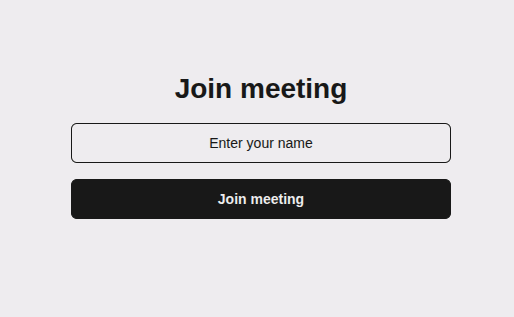
Picking a display name is completely optional. If you do not pick a display name, it will default to your ordinally assigned, zero-indexed meeting identifier. There are two ways to enter a display name, which are: 1. Holding your left eye shut for at least two seconds or pressing the right arrow on your keyboard to enable gesture detection followed by hovering the head cursor over the form field and hovering over the virtual keys until each one briefly turns gray in order to enter a display name, and 2. Using an external keyboard or dictation system.
If enabling gesture detection, make sure your face is well-lit.
Then either dwell on the “Join meeting” button with the head cursor until the progress circle fills completely or click it using a mouse, touchscreen, or track pad.
Trussal does not collect or store your personal information.
Meeting rooms
Implementation
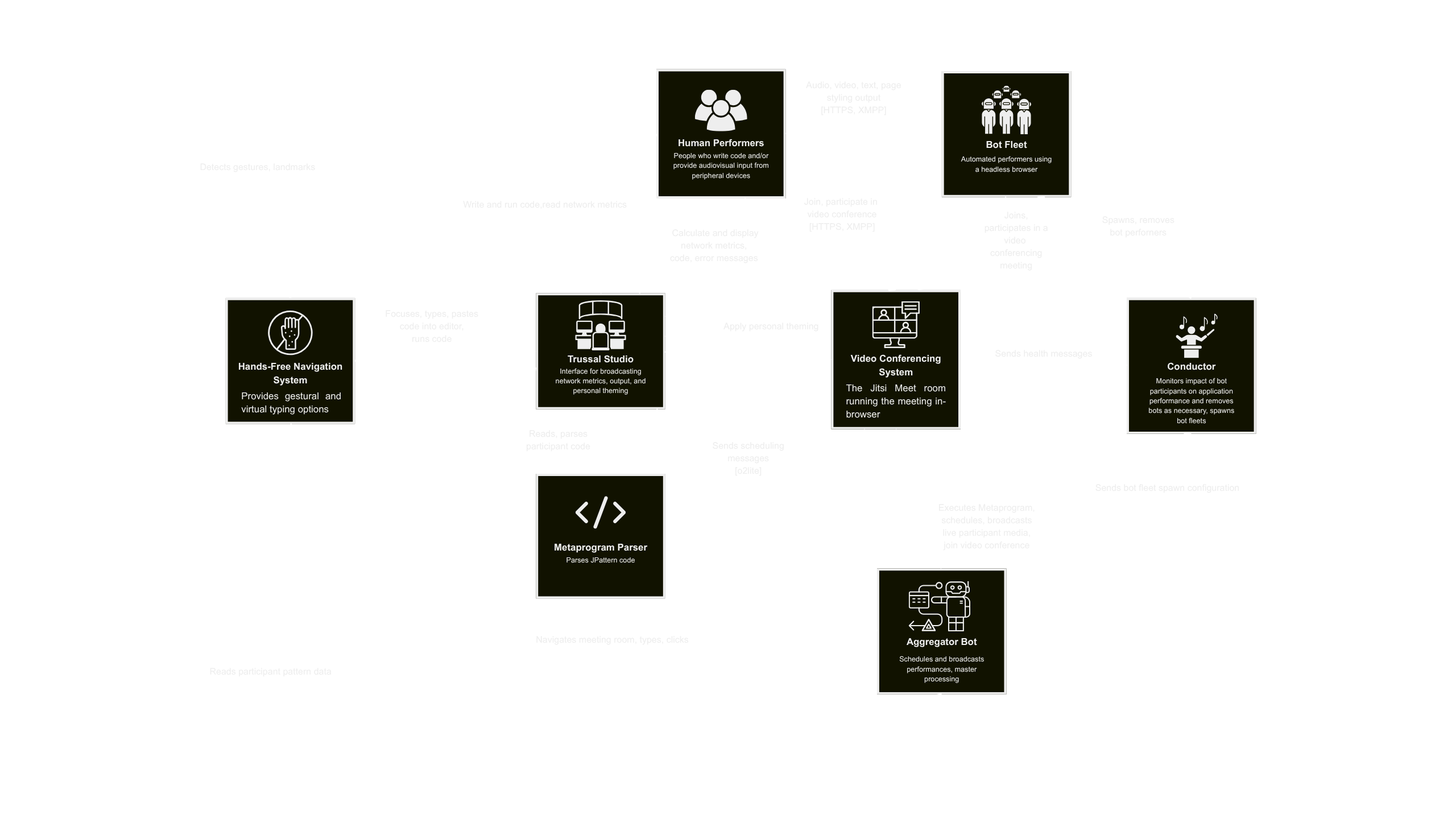
Trussal has a microservices architecture and is implemented in JavaScript. Via o2lite, participants communicate with a centralized scheduling bot. Below is a high-level architecture diagram.
Future Directions
The scaling of Trussal’s server infrastructure coupled with aggressive optimization that does not sacrifice the aesthetic experience is in order. Additionally, accessibility features could continue to be refined by seeking the feedback of users with a much more diverse range of physical and cognitive differences, as well as from those who have no programming experience.
Extending Trussal’s authentication abilities, allowing for smoother integration with third-party platforms, and codifying JPattern support beyond the Strudel and Jitsi Meet ecosystems could increase the application’s feasibility as online performing arts event infrastructure. Migrating from using Jitsi Meet’s Docker image to lib-jitsi-meet will allow for greater, more fit-for-purpose UI customizability white retaining the familiar video conferencing UI features that carried social ecosystems through the most recent global pandemic.
Furthermore, there is the possibility for integration with other hardware, such as brain computer interfaces, AAC devices, and other assistive technology.
Gallery
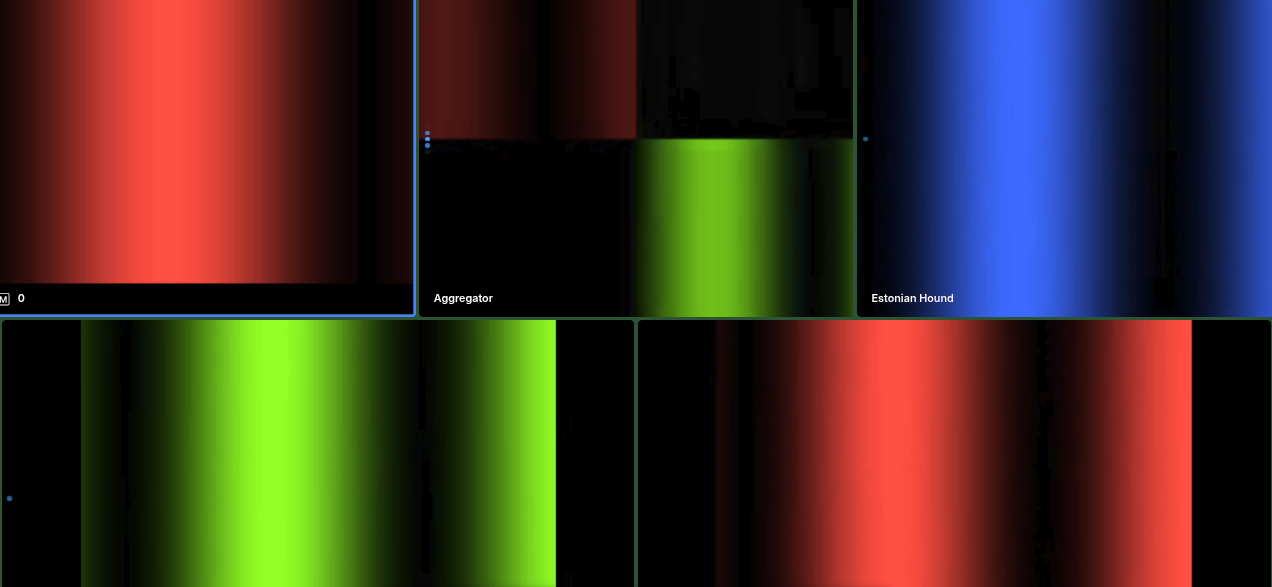
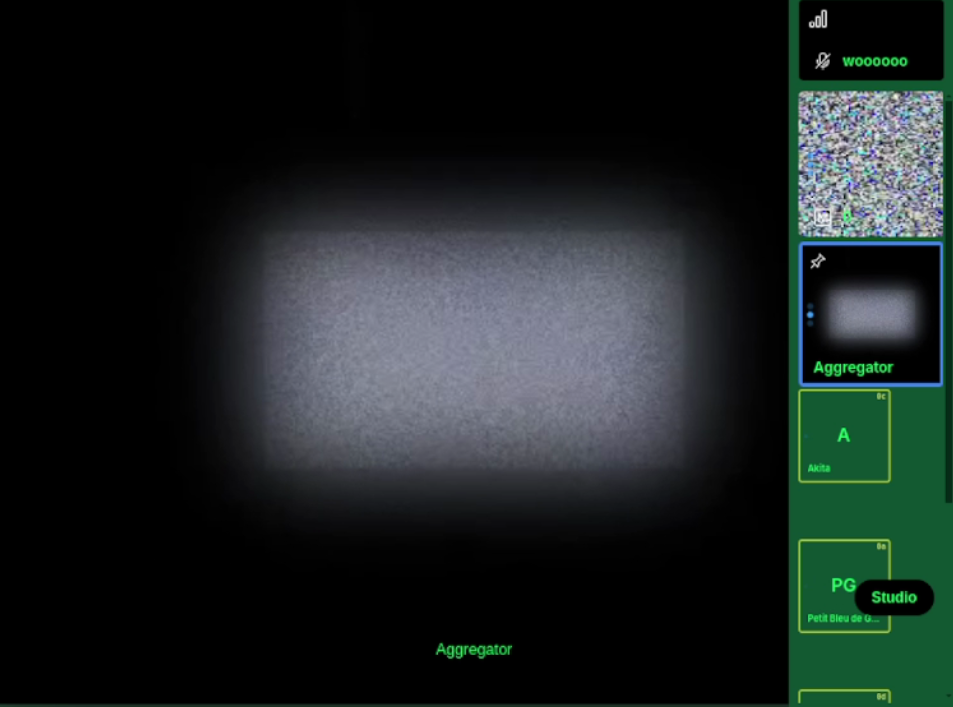
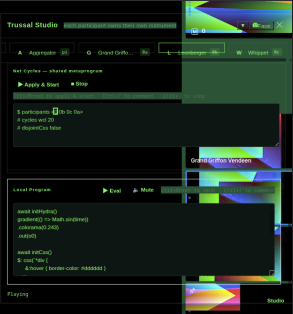
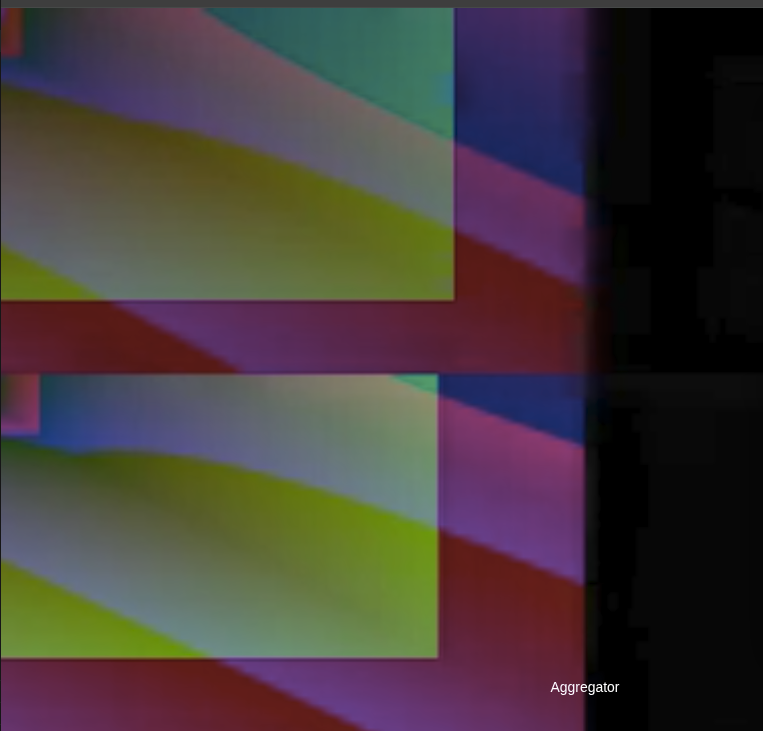
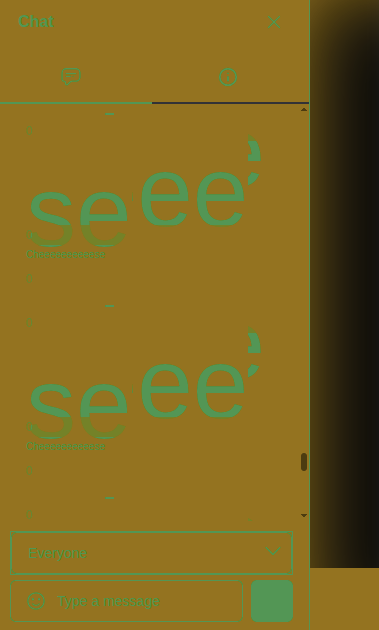
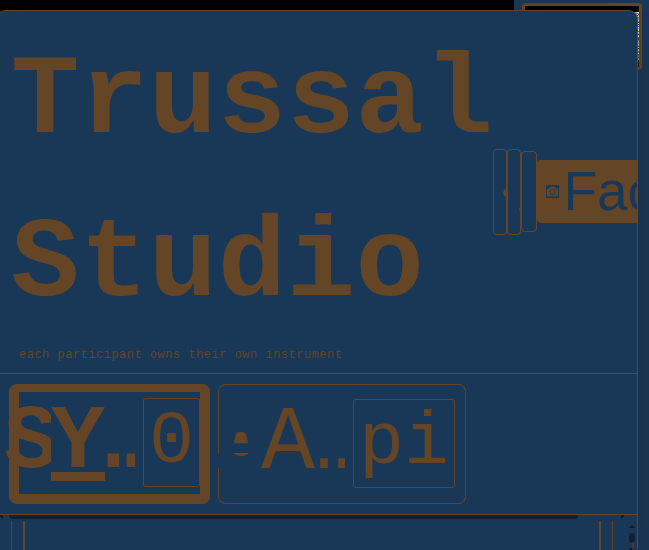
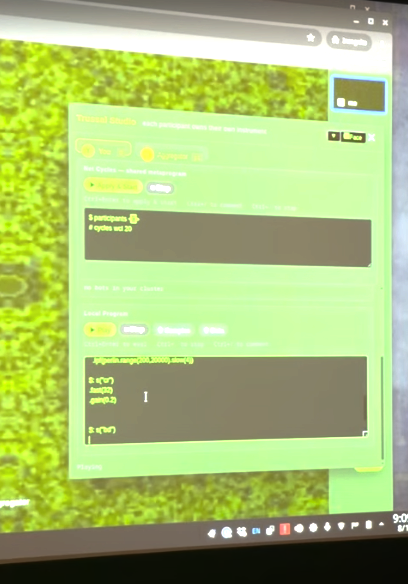
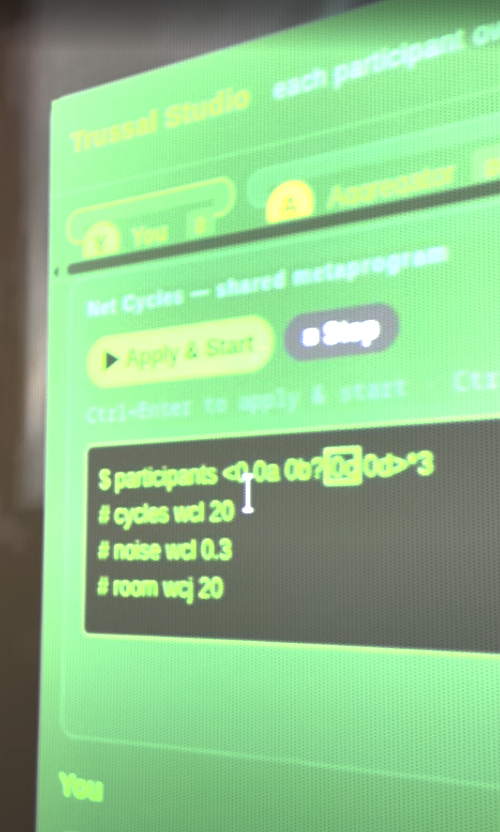
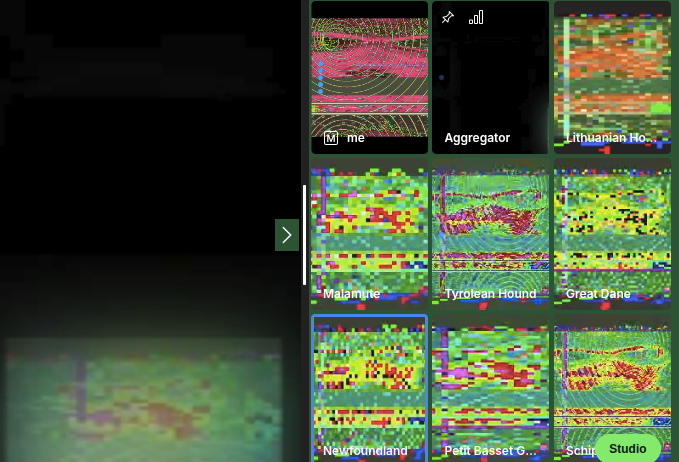
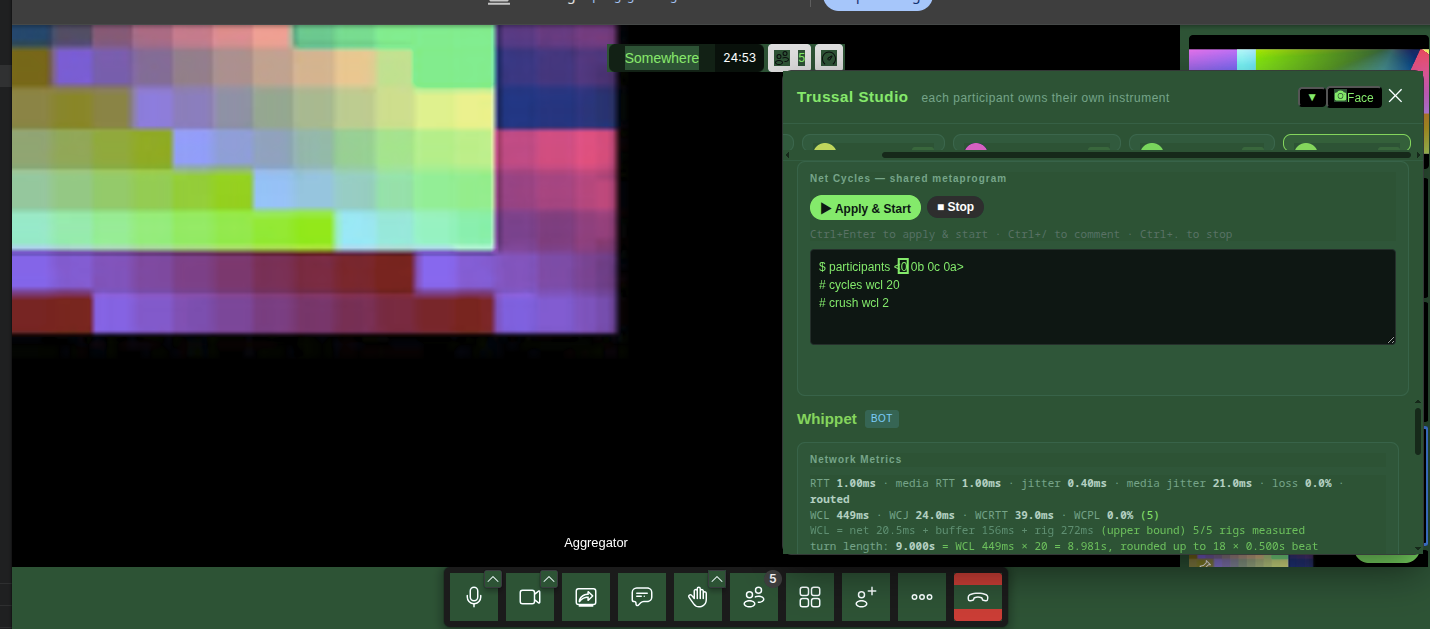
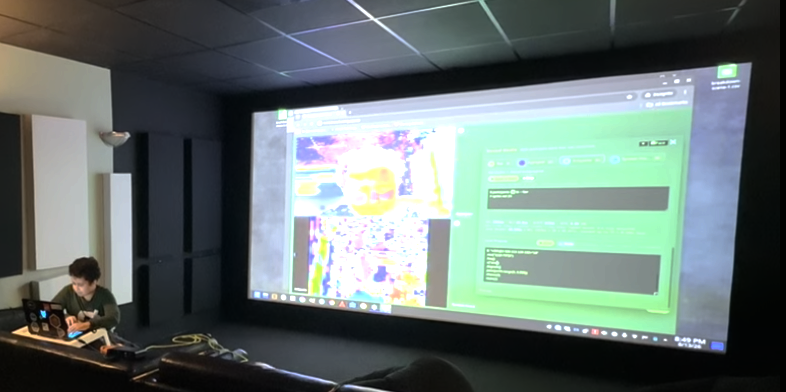
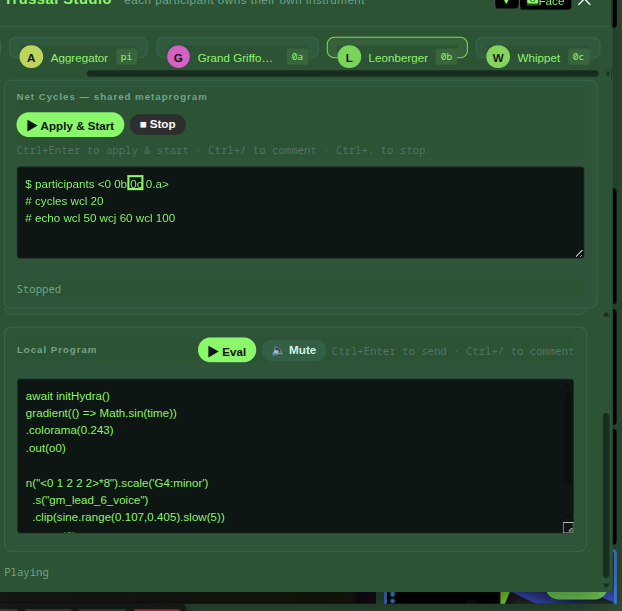
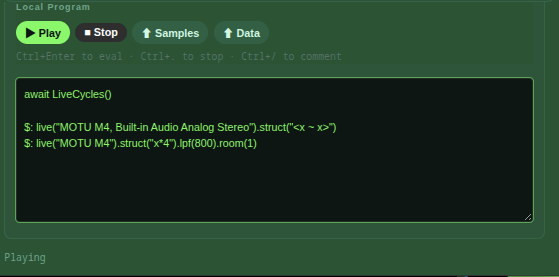
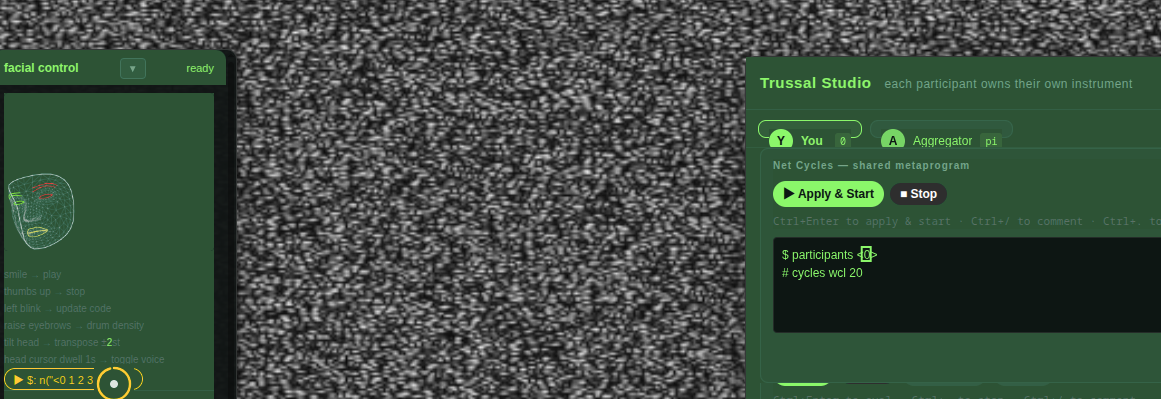
Below you will find a variety of images from Trussal meetings. Note that certain assets reflect an older UI version and the layout and default color scheme may be different.
Images


Videos
Frequently Asked Questions
Q: What is the primary research question?
A: Can Dannenberg and Liloia’s (2025) work on the Global Drum Circle support an extension of the cyclic fake time approach to a wide variety of pitched instruments in live, collaborative, and remote social settings over video conference?
Q: What broader problem(s) could Trussal solve?
A: Providing access to a musical medium with multimedia capabilities that exists online when attendance at an in-person venue may prove prohibitive, or cause undue hardship upon a performer or audience member, and in a manner that establishes authority as an artistic medium distinct from live in-person musical performance (Gabriela; 2022).
Q: There are many editors. What does that mean?
A: The bottommost editor in Trussal Studio when not focused on a bot is one’s own editor. It should have the ‘personal editor’ preprocessing directive. Only you can edit your own program. The editor above it is an interface for a CRDT document that stores a Metaprogram created by all participants together and executes code that affects all meeting room participants. Bots’ editors have the ‘bot editor’ preprocessing directive and their code can be edited by their respective spawning human meeting participants.
Q: Is it not physically impossible to perform with people far away, especially when it comes to audio?
A: It is true that audio samples cannot travel faster than the speed of light, networked performances are quite easily perturbed by typical network conditions, and human perception is very unforgiving of much less latency in a live audiovisual performance compared to in speech applications. 40ms is approximately the upper bound for being able to compensate in a typical concert setting, whereas users having a conversation about tomorrow’s dinner tend to accept 100ms or more of round-trip latency (Konstantinos et al; 2025).
However, Trussal embraces this by offering delayed cyclical playback and network-modulated global audiovisual effects in a setting that minimizes the contrast between the video conferencing features and the performance by supporting multiple additional conference features, such as text and meeting reactions as possible live coded patterns.
Q: Is 50ms of round-trip latency really that big of a deal to performers?
A: Yes, it actually is. Humans have evolved to be able to sustain speech in a much broader range of conditions. The same cannot be said for modern mainstream approaches to music performance.
Q: How can I figure out when it’s my turn?
A: If your meeting participant identifier does not show up in the Metaprogram, which is the program corresponding to the code in the top editor,
you will not get a turn unless the Metaprogram is in consistent hashing mode. Otherwise, your identifier will have a rectangular outline. The only way to see your own video and hear your own audio is to call a combination of Hydra’s external source methods and pass one or more of your peripheral device names to liveCapture.
Q: Where can I learn more about JPattern?
A: There is a full JPattern reference at https://trussal.com/documentation. The syntax is very similar to Strudel’s syntax.
Q: Something happened all of a sudden without me touching anything. Why?
A: MediaPipe’s gesture detector can be very sensitive. You can print the current gesture map to the browser console or disable it by clicking the ‘x’ button on the gesture detection and virtual keyboard UI windows.
Q: Why live coding, Jitsi, and MediaPipe?
A: Live coding environments tend to natively endorse cyclic approaches to real-time media scheduling. Furthermore, live coding software spans numerous open source options that provide immediate access to versatile audiovisual synthesis and DSP capabilities.
In particular, Strudel and Hydra specialize in browser-based live coding, allowing for relatively OS-agnostic application portability compared to a desktop GUI environment, as well as usability outside of devices where one has already installed a separate application. The Strudel REPL comes with out-of-the box support for Hydra.
Similarly, Jitsi readily supports video conferencing in one’s browser and provides comparable social infrastructure to Zoom, the world’s first choice video conferencing platform during the COVID-19 pandemic.
Integration with MediaPipe arose out of the need to both support simultaneous acoustic instrument use, as well as a baseline accessibility feature for those with limited to no use of their hands.
Q: Where is the source code?
A: The Trussal source code can be found here.
Citations
Jitsi. 2021. “Free Video Conferencing Software for Web & Mobile | Jitsi.” March 10, 2021. https://jitsi.org/.
Liloia, Ari, and Roger Dannenberg. 2025. Exploiting Latency In The Design Of A Networked Music Performance System For Percussive Collective Improvisation. Zenodo. https://doi.org/10.5281/ZENODO.15698933.
“MediaPipe Solutions Guide.” n.d. Google for Developers. https://developers.google.com/edge/mediapipe/solutions/guide.
“Strudel REPL.” n.d. https://strudel.cc/.
“Trussal.” n.d. https://trussal.com/.
Tsioutas, Konstantinos, George Xylomenos, and Ioannis Doumanis. 2025. “Impact of Audio Delay and Quality in Network Music Performance.” Future Internet 17 (8): 337. https://doi.org/10.3390/fi17080337.
“One Platform to Connect | Zoom.” n.d. Zoom. https://www.zoom.com/.
“S